




Caring for Your VW ID.4 Battery: Best Practices for Morgantown’s Mountain Charging
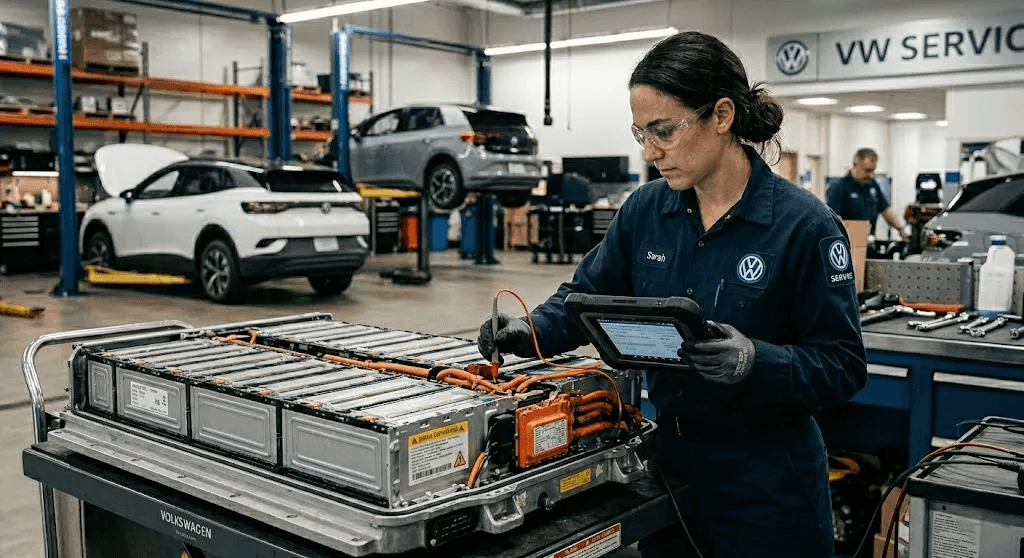
Last month, a 2022 VW ID.4 Pro came into our service bay with a battery that had degraded far faster than expected for its mileage. The owner had been charging to 100% every night and letting it sit depleted after long drives through the Mon National Forest. After just 28,000 miles, the pack was showing measurable capacity loss that should not have appeared until well past 80,000. A battery conditioning service and recalibration ran $380. The adjusted charging habits that would have prevented it? Completely free.
If you drive a VW ID.4 in Morgantown, you already know that this city asks more of an electric vehicle than most. The grades on Chestnut Ridge Road, the long descents off Grafton Road, and the unpredictable temperature swings between seasons all put your battery through conditions that flat-terrain EV owners never have to think about. Understanding how to work with those conditions rather than against them is the difference between a battery that lasts the life of the vehicle and one that starts underperforming long before it should.
The good news is that most of the habits that protect your ID.4 battery are simple once you know the reasoning behind them. This post walks through how your battery actually responds to mountain driving and charging, what signs to watch for, and what our service team at Volkswagen Morgantown sees most often from local ID.4 owners.
How Your ID.4 Battery Actually Works in Mountain Terrain 🔋
The ID.4 uses a lithium-ion battery pack that is sensitive to two things above almost everything else: temperature and charge level. In a city like Morgantown, both of those factors are in constant flux. Winters drop hard, summers get humid, and virtually every route in and out of the city involves significant elevation change.
When you climb a grade like the one heading out toward Kingwood on WV-7, your battery is discharging rapidly under heavy load. When you descend back into the Monongalia Valley, regenerative braking is pushing energy back into the pack. That cycle of heavy discharge followed by regen charging is not inherently harmful, but it does generate heat inside the battery, and heat is the primary accelerant of long-term lithium-ion degradation.
What Temperature Does to Your Range and Longevity
Cold temperatures slow the electrochemical reactions inside your battery cells, which reduces available range and makes the pack less efficient at accepting a charge. Most Morgantown ID.4 owners notice a range drop of 15% to 25% during January and February compared to mild weather months. That is normal and expected behavior.
What causes lasting damage is charging a cold, deeply depleted battery at high speed without preconditioning. When cell temperature is low and you plug into a DC fast charger on I-79 after a long winter drive, the pack absorbs energy unevenly, which stresses individual cells over time. Using your ID.4’s built-in preconditioning feature before arriving at a fast charger is one of the most protective habits you can build.
Best Charging Practices for Morgantown Drivers
The single most impactful thing you can do for your ID.4 battery is manage your daily charge ceiling. Volkswagen recommends keeping routine charging between 20% and 80% for everyday use. Charging to 100% every night keeps your cells in a state of high voltage stress for hours at a time, which compounds into measurable capacity loss over years of use.
For most Morgantown commutes, including the drive from Suncrest down to downtown and back, an 80% charge is more than sufficient. Reserve full charges for longer trips where you genuinely need the full range, such as drives to Clarksburg or Fairmont and back.
Here is a practical breakdown of charging costs and habits that protect your battery long term:
- Level 2 home charging (80% daily limit): $1.50 to $3.00 per full session depending on WV utility rates
- DC fast charging (occasional use, trips over 100 miles): $10 to $18 per session at public stations along I-79
- Battery conditioning service at the dealership: $300 to $450 if degradation is caught early
Keeping fast charging as a road trip tool rather than a daily habit is one of the most effective ways to slow degradation over the life of the vehicle.
Warning Signs Your ID.4 Battery Needs Professional Attention
Catching battery issues early keeps repair costs manageable and prevents minor degradation from becoming a warranty or replacement conversation. Pay attention to these indicators on your regular drives around Morgantown.
Sudden range drops that don’t match the weather. Some range loss in winter is normal, but if your estimated range drops significantly between charges without a clear temperature explanation, your battery management system may be recalibrating around degraded cells.
Charging that stops short of your set limit. If you set your charge ceiling to 80% and the car consistently stops at 74% or 76%, that is a signal worth investigating. It often indicates the battery management system is working around cells that are no longer performing reliably.
Longer than usual charging times. If your Level 2 sessions are taking noticeably longer than they did when the vehicle was new at the same charge level, internal resistance in the pack may be increasing.
Reduced regenerative braking feel on descents. If the regen feel coming down Grafton Road or off the Mileground hill feels weaker than it used to, the pack may be less able to accept energy efficiently.
Heat warnings or battery management alerts. Any dashboard warning related to battery temperature or charging should be treated as a prompt for an immediate service visit, not something to monitor and see.
Visible range inconsistency between similar trips. If your commute to WVU’s downtown campus returns wildly different energy consumption figures on similar weather days, the battery may be managing around internal imbalances.
Charging interruptions at fast chargers. Frequent session drops or errors at DC fast chargers that other vehicles use without issue can point to a communication problem between your battery management system and the charger, often tied to cell-level irregularities.
What Morgantown’s Mountain Roads Do to Regenerative Braking 🏔️
Regenerative braking is one of the ID.4’s most valuable tools on Morgantown’s terrain, but it works best when the battery has room to accept the recovered energy. This is one of the less obvious reasons why arriving at a long descent with a battery already at 95% or 100% is counterproductive. When the pack is nearly full, the vehicle reduces regen capacity to avoid overcharging the cells, which means you are riding your friction brakes down the hill instead of recovering energy.
Planning your charge level with your route in mind is a habit that pays off in both battery health and range efficiency. If you know you are heading out on WV-705 toward Cheat Lake and back, starting at 75% rather than 95% gives the regenerative system full room to work on the return descent.
Marcus T. from Star City had been charging his 2023 ID.4 AWD to 100% every evening before his commute to downtown Morgantown. After 18 months, he noticed the regen braking felt noticeably weaker on his usual route down from Suncrest. A battery inspection at Volkswagen Morgantown confirmed the pack had developed a mild imbalance from the consistent high-voltage storage. Adjusting his charge ceiling to 80% and completing a cell balancing service for $290 stabilized the issue before it progressed further.
The Real Cost of Ignoring Battery Health
Battery replacement on an ID.4 is not a minor service item. A full pack replacement runs between $12,000 and $18,000 depending on configuration, even with partial warranty coverage factored in. Keeping your battery healthy through smart charging habits and periodic inspections is not just about range, it is about protecting one of the most expensive components in the vehicle.
Here is what proactive battery care looks like versus reactive repair:
- Annual battery health inspection: $80 to $120
- Cell balancing or conditioning service: $290 to $450
- Partial module replacement (if caught early): $1,800 to $3,500
- Full battery pack replacement: $12,000 to $18,000
The math is straightforward. Two or three annual inspections over five years costs less than $600 total and gives you early warning on any developing issues before they reach module or pack territory.
What Your VW Technician Wants You to Know
“The number one thing I see with ID.4 owners in this area is charging to 100% every single night out of habit. On a flat terrain commute that might not show up for years, but with the elevation changes we have around Morgantown, the battery is already working harder than average. Keeping that daily ceiling at 80% and using preconditioning before fast charging makes a real difference over time,” says Ryan Callahan, EV Systems Technician at the Mary Jane Wood Circle location. “We can catch a lot of issues early with a simple battery health check. By the time someone notices a problem themselves, it has usually been developing for a while.”
Your 30-Day ID.4 Battery Action Plan
This week: Check your current charging settings in the ID.4’s charge management menu and set your daily charge ceiling to 80% if it is not already there. Spend a few minutes reviewing your recent charging history in the myVW app to see how often you have been reaching 100% and how long the vehicle has been sitting at full charge overnight.
Within two weeks: Pay attention to your regenerative braking feel on your regular routes around Morgantown, particularly on descents like Grafton Road or the Mileground. Note whether regen feels consistent and strong. If it feels noticeably weaker than it did months ago, that is worth flagging with a technician.
Here is a quick self-check to complete before your service visit:
- Note your current GOM (guess-o-meter) range at 80% charge and compare it to when the vehicle was new
- Check whether your fast charging sessions are completing without interruptions
- Review any recent dashboard alerts related to battery temperature or charging
By month’s end: Schedule a battery health inspection at Volkswagen Morgantown. A technician can pull detailed cell-level data that gives you a clear picture of where your pack stands and whether any preventive action is warranted. An annual inspection costs a fraction of what early intervention saves.
Schedule Your ID.4 Battery Inspection at Volkswagen Morgantown Today
Marcus from Star City adjusted his habits and completed a cell balancing service before his battery issue progressed, and his ID.4 has been performing consistently ever since. His story is a good reminder that the ID.4 is a capable vehicle for Morgantown’s mountain terrain, but it rewards drivers who understand how to work with its systems rather than against them.
Your battery is the most valuable component in your vehicle. Protecting it with smart daily habits and periodic professional inspections is the most cost-effective thing you can do as an ID.4 owner. The certified EV technicians at Volkswagen Morgantown have the VW-specific diagnostic tools to assess your battery health accurately and catch developing issues before they become expensive ones. Stop by or book your inspection online today at 401 Mary Jane Wood Circle, Morgantown, WV 26501, and drive Morgantown’s mountains with the confidence that your battery is in the best possible shape.

0 comment(s) so far on Caring for Your VW ID.4 Battery: Best Practices for Morgantown’s Mountain Charging