




Morgantown Game Day Prep: Ensuring Your VW is Tailgate-Ready
A Volkswagen Atlas owner came into our service bay the Monday after a WVU home game weekend after his vehicle had overheated in the stop-and-go traffic on Monongalia Avenue approaching the stadium parking areas. He had been idling in game day traffic for nearly two hours with the air conditioning running at full capacity and a full load of passengers on a warm September afternoon. The overheating event traced to a coolant level that had been marginally low for two months and a cooling system that had never been inspected since purchase eighteen months earlier. The cooling system service and pressure test cost $280. A pre-season inspection would have identified the low coolant for $0 as part of a routine multi-point service.
Morgantown on a WVU home game weekend is one of the more specific automotive stress tests that exists in the Mid-Atlantic region. The combination of extended stop-and-go idling on Beechurst Avenue and University Avenue as 60,000 fans converge on Mountaineer Field, the sustained cooling system demand from hours of low-speed traffic in September heat with a full vehicle of passengers and tailgate supplies, the I-79 grade work that fans driving in from Bridgeport, Fairmont, and Clarksburg navigate before they ever reach the stadium traffic, and the parking lot exit sequences that can extend a post-game vehicle idle period to lengths that normal commuting never produces puts a specific and concentrated load on every system that a routine maintenance interval might not test in the same way.
For Volkswagen owners in the Morgantown area who are season ticket holders, for visiting fans who drive up from Harrison County or Monongalia County’s surrounding communities for selected games, and for WVU students whose vehicles become the transportation solution for a tailgate group, game day preparation is not a metaphor for enthusiasm. It is a specific set of vehicle readiness checks that the game day environment makes consequential in ways that the Tuesday morning commute to campus does not.
At Volkswagen Morgantown, we see the post-game-weekend service requests that game day vehicle stress produces, and the pattern of what causes them and what prevents them is consistent enough across the season that every WVU fan who drives a Volkswagen deserves the specific information that makes game day vehicle preparation a two-hour service visit rather than a Monday morning tow.
What Game Day Traffic Does to Your VW’s Cooling System
The Atlas owner’s overheating event on Monongalia Avenue is the most dramatic game day consequence we see, but it is the predictable outcome of a specific set of conditions that the stadium approach traffic creates for any vehicle with a cooling system that has been operating with any margin of deficiency.
A Volkswagen engine that is operating normally at highway speed on I-79 from Bridgeport generates significant heat but also generates significant cooling airflow through the radiator from vehicle movement. A Volkswagen engine idling in stop-and-go stadium approach traffic on Beechurst Avenue for 90 minutes generates similar heat from running the engine and the air conditioning compressor but generates almost no cooling airflow because the vehicle is moving too slowly to produce meaningful ram air through the radiator. The cooling system’s electric fan does the work that ram airflow normally assists with, and on a warm September game day with a full passenger load and the AC running at its maximum demand to manage that passenger load, the electric fan is carrying a burden that a marginally low coolant level, a partially blocked radiator, or a thermostat that is beginning to stick makes more consequential than it would be during a normal commute.
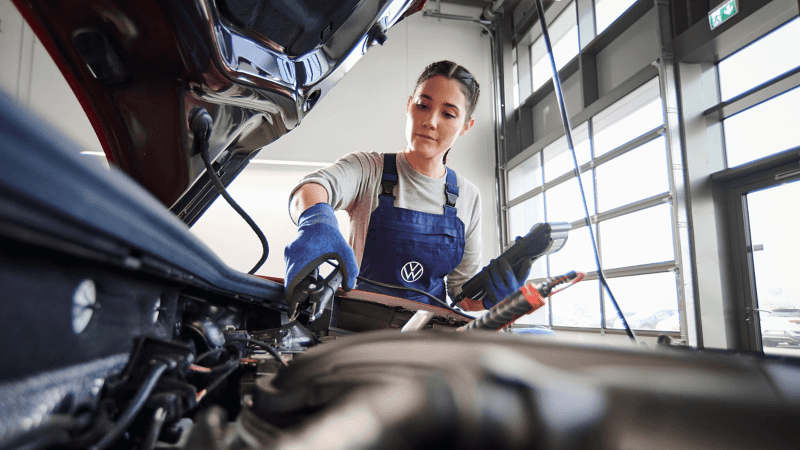
The cooling system inspection that prevents this outcome is not a complex or expensive service. It is a coolant level check, a pressure test of the cooling circuit to identify any leak that is keeping the level low, a thermostat function assessment, and a radiator visual for blockage from road debris or insect accumulation on the front face. All of these items are included in our multi-point inspection at every oil change visit, and any of them that presents a finding in August or September, before the first home game, is a finding worth correcting before the stadium traffic tests the marginal system at maximum demand.
What the I-79 Pre-Game Run Does to Brakes and Tires 🏔️
The fans who drive to Morgantown for home games from Bridgeport, Clarksburg, Fairmont, and the communities along I-79’s north-south corridor are making a trip that includes the grade sections between Bridgeport and Morgantown that we have discussed in other posts as one of the more demanding brake environments in North Central WV. A Volkswagen with marginal brake pads making that run in Saturday morning pre-game traffic, followed by two hours of stadium approach braking, followed by the return descent on I-79 after the game, is putting a brake system through a concentrated version of the demand that the I-79 route represents in normal commuting.
The tire condition question for game day is particularly relevant for fans who park in the remote lots that require driving on the gravel and uneven surface approaches that some Morgantown game day parking configurations use. A tire with adequate tread for normal Morgantown surface street driving but with sidewall cracking from age or UV exposure is more vulnerable to the lateral stress of a loaded vehicle on a gravel parking area surface than it is on the smooth pavement of Mary Jane Wood Circle or University Avenue.
The battery question deserves specific mention for game day because the sequence of a cold start on a fall morning in Morgantown, followed by extended low-speed idling with high electrical load from audio systems, charging multiple phones, and running the climate control for a full vehicle of passengers, followed by the post-game parking lot exit sequence that can involve extended additional idling, is a battery demand cycle that a marginal battery handles differently than a healthy one. A battery that starts the vehicle reliably on a normal September Tuesday morning may not maintain its charge adequately through the game day demand cycle, and the vehicle that fails to start in the Mountaineer Field parking lot after a WVU victory is a specific kind of memorable for the wrong reasons.
What Game Day Preparation Costs vs. What Game Day Failures Cost 💰
The game day preparation investment at Volkswagen Morgantown is modest relative to what a game day vehicle failure produces in time, money, and game day experience:
Pre-game season vehicle inspection:
- Cooling system inspection and pressure test: $65 to $95
- Battery load test: $0 included with oil change, $25 standalone
- Brake inspection with I-79 commute assessment: $0 included with oil change, $45 standalone
- Tire condition and pressure check: $0 included with oil change, $25 standalone
- Complete pre-season game day inspection package: $95 to $145 addressing all four systems
Game day failure costs:
- Overheating event tow from Morgantown stadium traffic: $95 to $180
- Emergency cooling system repair at an unfamiliar facility: $280 to $580
- Battery failure jump and tow from Mountaineer Field parking: $150 to $280
- Missed game or delayed departure from post-game failure: No dollar amount captures the full cost
- Emergency tire service in Morgantown on game weekend: $185 to $320 plus the wait
A WVU fan who spends $145 on a pre-season game day inspection before the first home game arrives at every subsequent game weekend with confidence rather than the background awareness of a vehicle system that has not been checked since spring. A fan whose vehicle produces a Monday morning service appointment from a Saturday game day event has paid more for the correction than the inspection would have cost and has added the game day disruption that the inspection would have prevented.
A Season Ticket Holder Who Made It a Ritual
The Millers are a Morgantown family with WVU season tickets who host a tailgate group of eight for every home game at Milan Puskar Stadium. They drive a Volkswagen Atlas and learned after a close call with an overheating warning light on Beechurst Avenue during the second home game of a previous season that game day traffic is a different stress test than their normal Morgantown commuting. They now bring the Atlas in for a pre-season inspection every August before the schedule begins, and they combine it with a mid-season check after the bye week. Their Atlas has made it through three subsequent seasons of full home game attendance without a vehicle-related incident. David Miller described the pre-season visit as the least expensive part of their game day preparation and the one with the most consequential return, noting that an overheating Atlas on Beechurst Avenue with eight fans and a full tailgate setup is a specific kind of disaster that $145 reliably prevents.
Warning Signs Your VW Needs Attention Before Game Day ⚠️
These indicators in the weeks before or during the WVU home game season suggest a vehicle that needs attention before the next stadium traffic test rather than during it:
Temperature gauge that climbs higher than normal in stop-and-go Morgantown traffic: A temperature gauge that reaches higher than its normal operating position during routine stop-and-go on University Avenue or Beechurst Avenue is showing a cooling system that is working at the upper boundary of its designed capacity under normal demand. Stadium game day traffic with a full passenger load and AC running at maximum will push that boundary further than the test the daily commute provides.
Battery that takes noticeably longer to start the engine on cool fall mornings: A cold start that is slower than normal in September or October on a Morgantown fall morning is the battery communicating that its cold cranking capacity has declined. The game day electrical demand cycle, which includes extended idling with high accessory load, will push a marginal battery harder than the normal commute reveals.
Brake squeal that appears specifically during the I-79 descent toward Morgantown: The wear indicator squeal that signals pad replacement due is particularly worth acting on before game day for fans who make the I-79 run from Harrison County. A pad at the squeal stage making the pre-game I-79 run, two hours of stadium approach braking, and the post-game I-79 descent is a brake system being asked to manage the highest-demand version of that route on pads that have already communicated they are at their service limit.
Tires that show visible sidewall cracking from multiple Morgantown winters: Age-related sidewall cracking that has developed through multiple WV winters and UV cycles is most relevant on game day when the vehicle is at full passenger and tailgate supply weight and navigating the gravel and uneven surfaces of remote stadium parking areas. A tire that holds air adequately on smooth Morgantown pavement may respond differently to the lateral stress of a heavily loaded vehicle on a parking area surface.
Coolant reservoir that is consistently at the low end of the acceptable range: A reservoir that is always at or near the minimum line rather than at the full line has a leak that has not been identified. The game day cooling system demand does not create a comfortable margin for a system that is already at its minimum fluid level entering the stadium traffic.
Oil life monitor below 20 percent going into a home game weekend: A vehicle with nearly depleted oil making the game day cycle of I-79 grade work, extended idling, and the return I-79 run is operating on oil that has less protective capacity than fresh oil. The game day cycle is not the right context for discovering the oil life monitor needed attention two weeks ago.
Check engine light that appeared and has been present for more than a week without diagnosis: Any stored fault code that is producing a visible check engine light is an unknown condition being taken into the game day stress environment. A fault that has been developing without diagnosis for a week before a home game weekend is a fault that will be tested by the game day demand cycle before it is corrected.
What Our Service Team Says
“We see the post-game Monday service appointments regularly through the WVU season, and the causes are almost always the same things: a cooling system that had a marginal condition that the stadium traffic exposed, a battery that the game day electrical demand cycle pushed past its reserve, or a tire that failed on the parking lot surface that road driving had not challenged the same way. The pre-season inspection before the first home game is the appointment that converts those Monday morning calls into non-events. It takes less than two hours, it costs less than a round of tailgate food for the group, and it checks the four systems that game day traffic specifically tests in ways that normal Morgantown commuting does not.” — Chris Alvarez, Lead Service Technician, Volkswagen Morgantown
When Pre-Season Service Kept a Tradition Unbroken
Patricia has attended every WVU home game for eleven years and drives her Volkswagen Tiguan from her home near the WVU Coliseum to a remote parking area for each game, shuttling tailgate supplies and family members through the pre-game and post-game Morgantown traffic that eleven years of experience has not made feel routine. She established the pre-season inspection as an August ritual after a brake squeal on the I-79 descent before the third home game of a previous season sent her to our facility on a game week with less notice than she would have preferred. The inspection that August found front pads at 2.5mm, appropriate for the pre-season finding given the I-79 use her Tiguan accumulates through the season. The replacement before the season began cost $225 and her Tiguan made eleven subsequent home games without a brake-related concern. She described the pre-season inspection as the preparation that made the tailgate tradition sustainable rather than annually anxious.
Your 30-Day Game Day Prep Plan
This week, if WVU’s home game schedule is within 30 days and your Volkswagen has not had a service visit since spring, pull up the oil life monitor reading and the date of the last service. If either the monitor is below 30 percent or the last service was more than six months ago, schedule a service visit at Volkswagen Morgantown before the first home game rather than between games when the schedule is most compressed. The pre-season timing gives our team the flexibility to address any findings before the game day stress test rather than concurrently with it.
Within two weeks, do a walk-around inspection of your VW’s tires before the first home game weekend. Note any sidewall cracking, check the tread depth with a quarter at the center and edge grooves of each tire, and confirm the pressure is at the door placard specification. If any tire fails the quarter test or shows significant sidewall cracking, schedule a tire service before the first game rather than during a game week when service scheduling is more compressed by the same fan traffic that creates the game day vehicle stress in the first place.
By month’s end, establish the August pre-season inspection as a standing item on your WVU fan preparation calendar alongside season ticket pickup and tailgate supply organization. Our team can set a standing annual appointment that falls in the last two weeks of August every year, before the schedule’s first home game, and that covers the four systems the game day environment tests most directly. These steps cost less than any other preparation item on the game day checklist and prevent the only one that would actually end the tradition.
Schedule Your Game Day Prep Service at Volkswagen Morgantown
The Atlas owner whose overheating event on Monongalia Avenue produced a Monday service appointment and a missed third quarter came back the following August for a pre-season inspection and has not missed a down since. His cooling system, battery, brakes, and tires have been confirmed ready before every subsequent home game season, and his tailgate group has attributed the unbroken attendance record partly to his vehicle preparation and partly to WVU football. We will take partial credit for the former and no credit for the latter.
Our team at Volkswagen Morgantown is located on Mary Jane Wood Circle, less than two miles from Mountaineer Field, which makes us the natural pre-game season service facility for every WVU fan who drives a Volkswagen to the stadium. We understand the game day traffic pattern, the I-79 pre-game run, and the specific vehicle stress that Morgantown on a home game Saturday produces. We are here to make sure your VW is ready for every one of them.
Visit us at Volkswagen Morgantown, 401 Mary Jane Wood Circle, Morgantown, WV 26501. Our service department is open Monday through Saturday. Schedule your game day prep inspection online through our website or speak with one of our service advisors directly. We serve drivers from Morgantown, Star City, Westover, Granville, Fairmont, and throughout Monongalia County. WVU home games are too important to spend in a parking lot waiting for a tow. Let’s make sure your VW is ready for kickoff. 🏈

0 comment(s) so far on Morgantown Game Day Prep: Ensuring Your VW is Tailgate-Ready